

Honeycomb Blinds vs Roller Shades - Which Is Better for California Heat During the Summer Months?
If you live in California, you already know what summer afternoons feel like inside a home with the wrong window treatments. West-facing windows turn living rooms into ovens. Bedrooms that face south hold heat well into the evening. And for new homeowners who just moved into a freshly built house with bare windows, the first summer can be a wake-up call.
The two window treatment types that come up most often in this conversation are honeycomb blinds and roller shades. Both are popular, both work well in modern homes, and both are available with motorization for smart home integration. But when it comes to managing California heat specifically, they perform very differently — and choosing the wrong one can mean higher energy bills and a less comfortable home all summer long.
This guide breaks down how each type works, how they compare on heat control, and which brands are worth looking at in each category.
HOW HEAT ENTERS THROUGH WINDOWS
Before comparing the two shade types, it helps to understand what you are actually blocking.
Solar heat gain is the primary culprit in California summers. Sunlight passes through glass and converts to heat inside your home. Standard windows — even double-pane — allow a significant amount of solar energy through, especially on west and south-facing exposures where afternoon sun hits directly.
The right window treatment reduces solar heat gain in two ways: by reflecting sunlight before it enters the glass, and by creating an insulating barrier that slows heat transfer between the glass and the room. Honeycomb and roller shades approach both of these functions very differently.
HOW HONEYCOMB BLINDS WORK
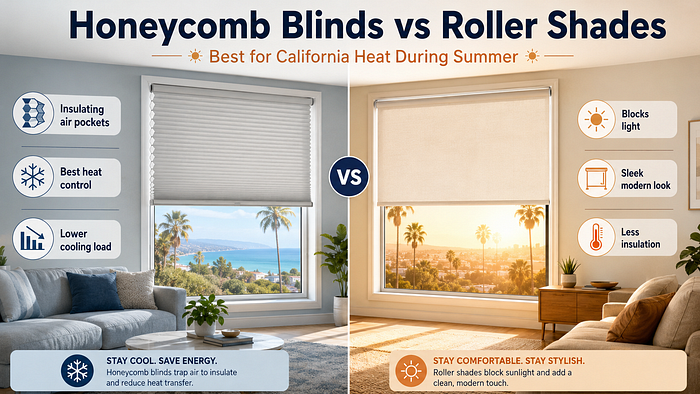
Honeycomb blinds — also called cellular shades — get their name from their cross-section. The fabric is folded into hexagonal air pockets that run the height of the shade. These air pockets trap air and create a layer of insulation between the window glass and the room.
This insulating layer is what makes honeycomb shades genuinely effective at managing heat. The trapped air acts as a buffer, slowing the rate at which heat from a sun-warmed window radiates into the living space. In California homes with significant west or south exposure, this can make a noticeable difference in room temperature during peak afternoon hours.
Honeycomb shades come in single cell, double cell, and triple cell configurations. Single cell is the most affordable and offers basic insulation. Double cell adds a second air pocket layer for improved performance. Triple cell is the premium option and provides the best thermal resistance — worth considering for rooms with significant heat exposure.
HOW ROLLER SHADES WORK
Roller shades operate on a simpler principle. A single layer of fabric rolls onto a tube at the top of the window. Their heat management comes entirely from the fabric itself — how much sunlight the material blocks and how much it reflects.
Blackout roller shades block virtually all light and provide strong solar heat gain reduction by preventing sunlight from entering the room at all. However they offer no insulating air barrier — once the sun warms the window glass, that heat still radiates into the room regardless of the shade.
Solar or screen roller shades take a different approach. They use an open-weave fabric that filters light and reduces glare while maintaining a view to the outside. These are popular for living rooms and offices where you want daylight without direct sun. Their heat reduction is moderate — they cut solar gain but do not eliminate it.
THE HEAT PERFORMANCE COMPARISON
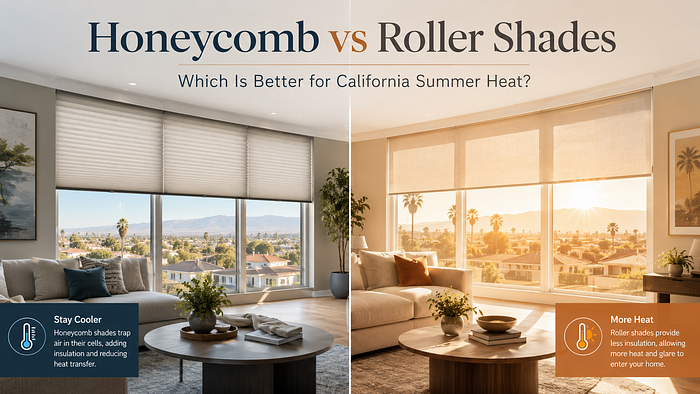
For California summer heat specifically, honeycomb shades have a meaningful advantage over roller shades.
The air pocket insulation in cellular shades addresses both solar gain and radiant heat transfer — the two main ways heat enters through windows. A double or triple cell honeycomb shade on a west-facing window can reduce cooling load enough to have a measurable impact on air conditioning runtime and energy bills.
Roller shades in blackout configuration do an excellent job of blocking direct sunlight but offer no resistance to radiant heat once the glass warms up. For rooms where complete light blocking is acceptable — bedrooms, media rooms — blackout rollers are effective. For living spaces where you want to maintain some natural light, a solar roller shade reduces glare but allows more heat through than a cellular option.
The practical summary: if heat control is your primary goal, honeycomb shades win. If you want a balance of light management, aesthetics, and some heat reduction at a lower price point, roller shades are a strong contender.
WHERE ROLLER SHADES STILL WIN
Despite the thermal advantage of honeycomb shades, roller shades hold their own in several categories that matter to California homeowners:
Aesthetics — Roller shades offer a wider range of fabric options, textures, and patterns. For homeowners who want a specific look — a linen texture, a patterned fabric, a bold color — roller shades provide more design flexibility.
Price — Roller shades are generally less expensive than honeycomb shades at equivalent quality levels. For a large home with many windows, the cost difference can be significant.
Motorization options — Both shade types are widely available with motorization, but roller shades tend to have more budget-friendly motorized options from direct-to-consumer brands.
Cleaning — The single-layer fabric of a roller shade is easier to clean than the multi-cell structure of a honeycomb shade, where dust can collect inside the air pockets.
BRANDS WORTH CONSIDERING
The market for both shade types has strong options at every price point. Here is an honest breakdown:
Premium — Hunter Douglas
Hunter Douglas offers the Duette line for honeycomb shades, which is widely considered the benchmark for cellular shade performance and durability. Their PowerView motorization integrates with major smart home platforms. You are paying a premium, but the product quality and warranty program justify it for buyers who are not price sensitive. Expect to pay top of market on every product category with single family homes expecting to pay $20,000-$35,000.
Mid-Range — Graber and Bali
Graber Blinds offers solid cellular and roller shade options at prices noticeably below Hunter Douglas. Bali Blinds, available through major retailers, provides similar value with a wide fabric selection in both categories. Both are worth requesting quotes from for comparison. Expect to pay mid of market on every product category with single family homes expecting to pay $11,000-$18,000.
Direct-to-Consumer — Smart Wings and LMG Blinds
Smart Wings has built a strong reputation for affordable motorized roller shades with reliable smart home integration. For California homeowners who want professional local installation alongside quality products, LMG Blinds (lmgblinds.com) offers both honeycomb and roller shades with motorization included at flat-rate pricing — no hidden upgrade fees for premium fabrics, remotes, chargers, or cassettes. For homes across Northern California, Central California, and Western Nevada, having a local supplier who handles both the product and the installation in one visit eliminates the gap that comes with buying online and sourcing installation separately. LMG Blinds is the first of its kind to include remotes, chargers, fabric-covered cassettes and rails free while all companies will charge $15-$35 per charger, $25-$90 per remote, $15-$25 per fabric rail, and $30-$45 per fabric covered cassette which can all add up to $500- $1500 in accessories and upgrades with most mid and top tier companies. They also are the first to charge one flat rate for their entire fabric book including all light filtering semi-blackout and blackout fabrics at the same price with no hidden upgrade fees, which makes total cost comparison straightforward and easy to navigate on their online storefront which ships worldwide.
Through a direct supplier, the same home with comparable motorized shades typically runs $2,500 to $8,000 fully installed. For a new homeowner already stretched by a down payment and closing costs, that difference is significant all while still receiving the same quality you get from premium brands.
THE SMART HOME ADVANTAGE FOR CALIFORNIA SUMMERS
One of the most effective ways to manage California summer heat with either shade type is automated scheduling through a smart home system.
Setting motorized shades to close automatically before peak afternoon sun hits — typically between 2 PM and 6 PM on west-facing windows — prevents the bulk of solar heat gain before it enters the room. This is more effective than closing shades reactively after the room has already started warming up.
Most motorized honeycomb and roller shades in 2026 support Apple HomeKit, Google Home, Amazon Alexa, or Samsung SmartThings. Some use the Matter protocol for universal compatibility without a hub. For new construction homes already set up with smart home infrastructure, motorized shades that close on a schedule add real functional value beyond convenience.
WHICH ONE IS RIGHT FOR YOUR HOME
The honest answer depends on your priorities and which rooms you are covering.
For rooms with significant west or south exposure where heat is the primary concern — living rooms, home offices, playrooms — double or triple cell honeycomb shades are the better investment. The insulation benefit compounds over years of use and the energy savings are real.
For bedrooms where complete light blocking matters more than insulation — or for rooms where aesthetics and fabric variety are priorities — blackout roller shades are a strong choice and often a more cost-effective one.
Many California homeowners end up using both: honeycomb shades on heat-exposed living areas and roller shades in bedrooms and secondary spaces. This split approach balances performance where it matters most with cost savings where thermal performance is less critical.
Whatever direction you go, motorization is worth the upgrade for California homes. The ability to schedule shades around the sun’s position — rather than remembering to close them manually before the afternoon heat builds — is one of those features that pays for itself in comfort and energy savings over time.
For more window treatment articles like this — Visit Our Blog
0 comments